
Service Area
Assessment
Office
Buildings
Planning
Closeout


SBS Modified Bitumen and Multi-Ply Redundancy for Critical Roofs
Not every FM wants a single-ply membrane, and for good reason. SBS modified bitumen gives a roof multiple layers of waterproofing instead of one, which matters most on buildings where a roof leak means a shutdown, not merely an inconvenience. That's the conversation we have most often around hospital and healthcare facilities and manufacturing floors that can't tolerate downtime.
Where Multi-Ply Redundancy Actually Matters
A single-ply membrane, whether TPO, EPDM, or PVC, is one layer standing between the building and the weather. If that layer gets compromised — a puncture, a seam failure, storm damage — water has a direct path in. SBS modified bitumen is typically installed in two or more plies, so a breach in the top cap sheet doesn't automatically mean a breach all the way through. That redundancy is why we still recommend it on buildings where downtime cost outweighs the higher install cost — surgical facilities, data-sensitive manufacturing floors, and any roof over space that can't afford water intrusion while a repair gets scheduled.
For a warehouse or standard retail box, that redundancy is usually more than the building needs. It's a spec that earns its cost on specific building types, not a universal upgrade.
Application Methods We Use
SBS modified bitumen goes down a few different ways depending on the deck and the building's fire and occupancy requirements. Torch-applied systems fuse the bitumen with direct heat, cold-applied adhesive avoids open flame entirely, and self-adhered sheets use factory-applied adhesive activated by pressure. On occupied buildings, especially anything with sensitive equipment or continuous operations below, we favor cold-applied or self-adhered methods to eliminate the open-flame risk that comes with torch application near an active facility.
Deck condition and existing roof assembly usually decide the method more than preference alone — a recover over an existing built-up roof calls for a different approach than new construction on a clean deck.
Granulated Cap Sheets and Weather Resistance
The top ply on most SBS systems is a granulated cap sheet, and those mineral granules do real work — they shield the underlying bitumen from direct UV exposure and add a layer of physical protection against hail impact. On roofs we've inspected after Stark County spring hail events, granulated cap sheets generally show less penetrating damage than an ungranulated membrane surface would, though granule loss over time is itself something we track as a sign of aging.
Cap sheet color also affects reflectivity, similar to the choice between black and white EPDM — a lighter granule color reduces surface temperature somewhat, though it's a smaller effect than a fully reflective single-ply membrane.
Conversions Off Old Built-Up Gravel Roofs
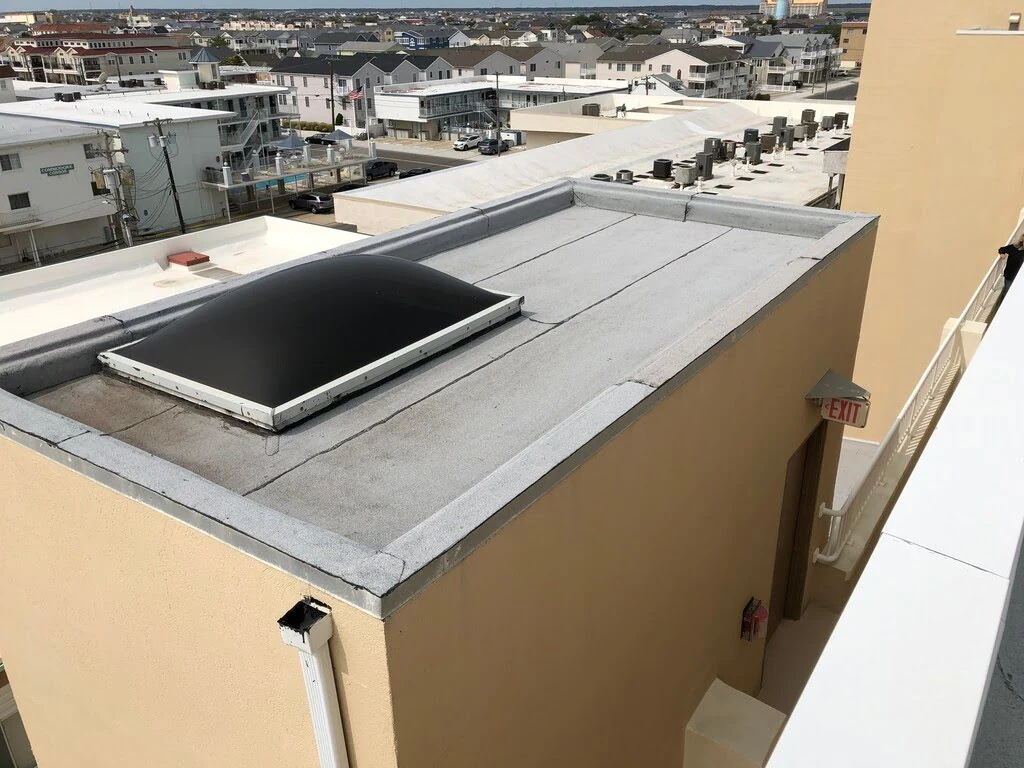
A fair number of the older commercial buildings around downtown Canton and the surrounding manufacturing corridors still carry original built-up gravel roofs from decades ago. When those roofs reach end of life, modified bitumen is often the natural conversion target — it uses similar installation logic and can sometimes tie into existing base flashing details more easily than switching to a single-ply system, particularly on complex older rooflines with a lot of penetrations and equipment curbs.
- Multi-ply system provides redundancy a single-ply membrane doesn't — a breach in one layer isn't automatically a breach through to the deck
- Cold-applied and self-adhered methods eliminate open-flame risk near occupied or sensitive space
- Granulated cap sheets add UV and hail protection compared to an exposed membrane surface
- Common conversion path for buildings coming off older built-up gravel roofs
- Flashing details often integrate more directly with older roof assemblies than single-ply retrofits do
Maintenance and Flashing Vulnerability
The field of an SBS roof is durable, but flashings at curbs, walls, and penetrations remain the most likely failure point, same as most roofing systems. Freeze-thaw movement stresses these details every winter, and we check them specifically on annual inspections rather than assuming the multi-ply field automatically means a maintenance-free roof.
Owners sometimes assume redundancy means they can skip inspections. We push back on that — redundancy buys time to catch and fix a problem before it becomes a leak, but it doesn't replace the inspection that catches it in the first place.
Common Questions About Modified Bitumen
Is SBS modified bitumen more expensive than TPO or EPDM?
Generally yes, both in material and labor, largely because of the multi-ply application. Where a building's downtime cost is high, that premium is often worth it for the added redundancy.
Can modified bitumen be installed without an open flame?
Yes — cold-applied adhesive and self-adhered sheet options avoid torch application entirely, and we use those methods routinely on occupied buildings or anywhere fire risk needs to be minimized.
How do I know if my old built-up roof should convert to modified bitumen versus single-ply?
We look at the existing flashing details, deck condition, and how the building is used. Complex older rooflines with a lot of penetrations often favor modified bitumen's more familiar detailing approach; simpler open rooflines are often better candidates for single-ply.
Does granule loss on my cap sheet mean the roof is failing?
Not immediately, but it's a sign of aging worth tracking. We note granule loss patterns during inspections and factor it into how many years of service life we estimate the roof has left.
Does the redundancy of modified bitumen mean fewer inspections are needed?
No. Redundancy buys time between a breach and an actual leak, but flashings and details still need the same inspection cadence as any other system to catch problems early.